
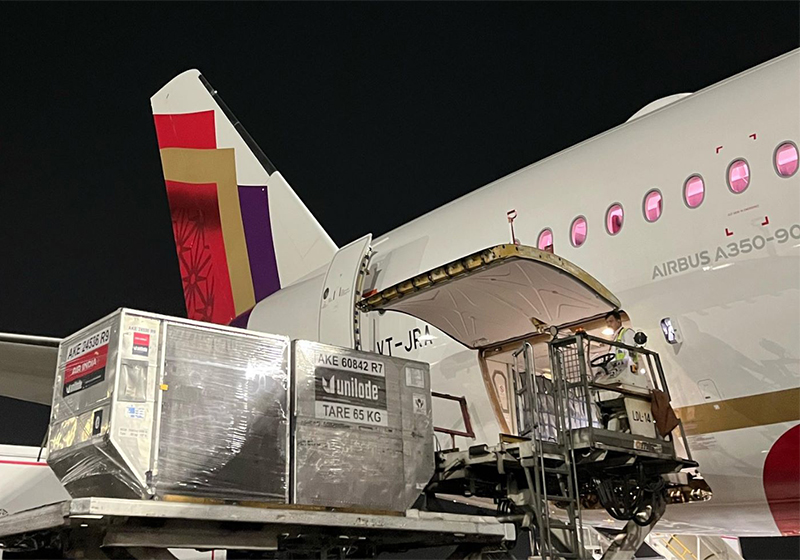
Air India has announced the successful operationalisation of the Government of India's new cargo transshipment policy through an ongoing Proof of Concept (PoC) on the Chennai-Delhi-Frankfurt air cargo corridor, launched on 20 June 2026. The new policy allows eligible cargo shipments to remain securely packed during transit, eliminating the need for piece-level re-screening and significantly reducing connection times and handling requirements while enabling faster, more efficient cargo movement without compromising safety or security.
Following the Government's approval to expand the pilot, Air India will now enable seamless cargo movements via Delhi for eligible shipments originating from five points in India (Ahmedabad, Bengaluru, Chennai, Hyderabad, Mumbai) and connecting onwards to three points in Europe: Copenhagen, Frankfurt, and London (Heathrow).
As supporting infrastructure is progressively implemented across the country, the Bureau of Civil Aviation Security (BCAS) has authorised Air India's PoC to validate the new process ahead of wider rollout.
Cargo throughput doubles on Chennai-Delhi-Frankfurt corridor
Air India successfully operationalised the 90-day PoC for the new policy, approved by BCAS. Over the course of two months, the reformed policy helped Air India to:
Double average cargo volumes on the Chennai-Delhi-Frankfurt corridor, from 2.2 metric tonnes (MT) per day to 4.5 MT per day
*Transport a total of 300 MT of cargo from Chennai to Frankfurt via Delhi between 20 June and 20 August 2026
*Reduce the average cargo connection time at Delhi Airport from 36-48 hours to 5-8 hours
*Improve Flown-as-Booked (FAB) performance from 76% to 100%, while recording zero cargo loss or damage during transit
* Deliver greater customer satisfaction, with top-tier freight forwarders like DHL, Dachser, DVS, and Kuehne+Nagel sharing highly positive feedback of their shipping experience
P. Balaji, Group Head - Governance, Risk, Compliance & Corporate Affairs, Air India, said: " The Honourable Prime Minister's vision for India’s aviation sector, and the Government’s broader agenda to strengthen logistics and connectivity extends beyond passenger growth to building world-class cargo and logistics capabilities that enable Indian airports to serve as global transit hubs. This new cargo transshipment policy is an important step towards that objective. By making cargo transfers faster and more efficient, it will help strengthen the competitiveness of Indian airports and support growth across the logistics value chain. We thank the Ministry of Civil Aviation, BCAS and all stakeholders for their partnership and support in making this pioneering initiative possible.”
Ramesh Mamidala, Head of Cargo, Air India, said: "This reformed cargo transshipment policy has the potential to be a game-changer for India's air cargo sector. By enabling seamless cargo transfers through Delhi, it can help attract transit traffic that currently moves through foreign gateways, unlock additional cargo volumes for Air India, and significantly improve aircraft belly utilisation across our expanding network. Delhi alone has the potential to attract more than 2 million metric tonnes of additional annual transshipment cargo across 95+ addressable international air cargo corridors. Beyond the airline industry, the benefits extend across the logistics ecosystem, supporting growth for freight forwarders, e-commerce, warehousing providers, ground handlers and allied services, while reinforcing Delhi's position as India's premier air cargo hub."