
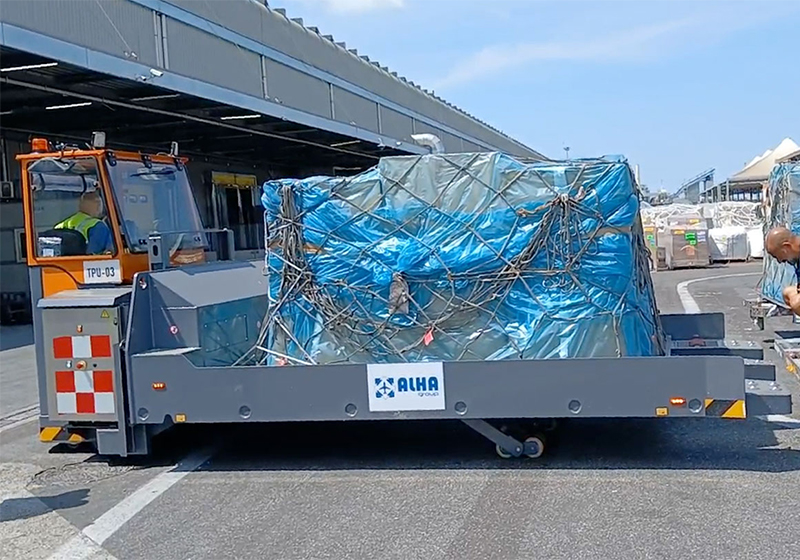
OMG Industry and ALHA Group present the case history of the new NEOS RD Air Cargo, the electric ULD Transporter customized to ALHA's operational requirements and currently in use at Rome Fiumicino Airport.
In the air cargo sector, efficiency does not depend only on the speed at which goods move through the terminal. It also depends on the ability to adapt processes and technologies to the actual characteristics of the available spaces, flows and infrastructure. It is precisely from this need that the project developed by ALHA Group and OMG Industry at Rome Fiumicino Airport originated.
At the terminal managed by ALHA, in fact, the absence of a fixed roller conveyor connecting the internal palletization area with the external apron areas required ULD handling to be carried out using slave pallets coupled to forklifts, resulting in several intermediate steps. The objective, therefore, was not to replace one vehicle with another, but to develop a non-standardized solution capable of adapting to the warehouse layout, the available spaces, cargo flows and the safety requirements of airport handling.
"The idea originated from the need to identify an innovative solution compared with traditional systems, capable of adapting to the configuration of our warehouse, the internal and external spaces, the type of cargo traffic at the airport and the safety criteria for ULD handling," explains Lorenzo Schettini Gherardini, President and CEO of ALHA Group.
Starting from daily operations, ALHA therefore defined the necessary requirements for the new vehicle: load capacity, deck dimensions, roller drive system, transfer height, maneuverability in confined spaces, autonomy, safety and the possibility of using the same vehicle both indoors and outdoors. Requirements that OMG Industry translated into a dedicated configuration.
"We worked hand in hand on the customization of the vehicles and on identifying specific solutions typical of our airport handling activities," underlines Schettini Gherardini.
The choice fell on a self-propelled configuration with a Powered Roller Deck, capable of receiving, transporting and directly transferring ULDs to compatible handling systems, without using a slave pallet as an interface. The new NEOS RD Air Cargo thus becomes a mobile link between different stages of the cargo flow, usable both inside the warehouse and on the external apron areas. Today, this special vehicle moves ULDs from inside to outside and vice versa and is also used for loading and unloading units from dollies.
"We have improved ULD handling times, both inside and outside our areas, and simplified the operational handling processes. In addition, the vehicle's compact footprint allows us to operate more safely in confined spaces," says Schettini Gherardini.
The feedback from the operators also confirms the effectiveness of the solution, as they have responded positively to the vehicle thanks to its ease of use and the benefits perceived in daily operations.
Transport and transfer in a single electric vehicle
From a technical point of view, the solution developed is a 100% electric self-propelled ULD Transporter, with an onboard operator and a load capacity of up to 8,000 kg. The 3,180 x 2,480 mm deck integrates a Powered Roller Deck with 4 powered rollers, 88 free-running rollers and 9 ball transfer units, while the 520 mm lift allows the deck height to be adapted to the different levels of the handling systems. In this way, the NEOS RD can operate as a mobile connection between receiving, preparation, storage and handling areas, making it possible to adapt the flow even in terminals where installing fixed connection infrastructure may be complex or inefficient.
Particular attention has also been paid to safety. The side-mounted seated operator position, together with a camera and monitor, mirrors, sensors, operator-presence devices and warning systems, facilitates control of the surrounding area during the different operational phases. The power supply is completely electric, with a 48 V – 775 Ah battery, a feature that eliminates local exhaust emissions and allows use both indoors and outdoors.
"It is an irreversible process that can no longer be avoided. Almost all of our handling equipment is electric," observes Schettini Gherardini.
This case history shows how, in the presence of complex layouts or infrastructure constraints, innovation can arise from the ability to develop solutions that can be adapted to actual operational requirements. Not a single model for all terminals, but flexible and configurable technologies according to available space, volumes, infrastructure and the organization of handling processes.