

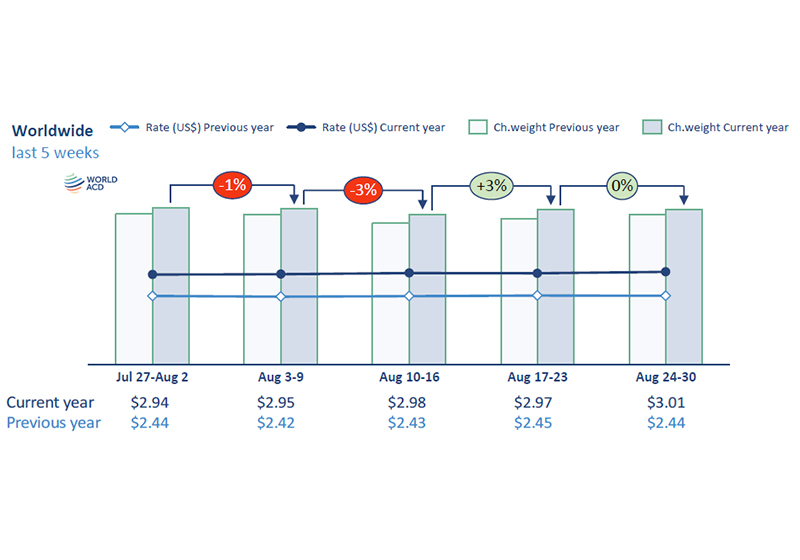
Global air cargo tonnages increased by 5% year on year in August 2026, indicating continued resilience in the international air freight market, according to the latest data from WorldACD Market Data. However, significant shifts are emerging across key trade lanes, particularly between China, Hong Kong and Europe, following the European Union’s decision to end its de minimis exemption for imports valued below €150 from July 1.
The most notable impact has been seen on the Hong Kong–Europe trade lane, where air cargo volumes fell by approximately 30% year on year in August and were 24% below June levels, just before the new EU import duty rules came into effect. The decline highlights how e-commerce companies and logistics providers are reassessing the use of air freight for relatively low-value cross-border shipments in response to the regulatory changes.
Despite the sharp decline, there are signs that Hong Kong–Europe traffic may be stabilising. August tonnages were around 7% lower than July, but weekly data showed volumes increasing 3% in week 35 (August 24–30) compared with the previous week and 6% above the low recorded in week 33.
Mainland China–Europe cargo has also shown signs of recovery. Volumes, which are less dependent on e-commerce shipments, have increased week on week for four consecutive weeks following an approximately 15% decline after the July regulatory changes. China–Europe tonnages were down 6% year on year in week 35, while August volumes declined 5% year on year, an improvement from the 8% decline recorded in July. Combined China and Hong Kong volumes to Europe were down 14% year on year in both July and August, compared with flat growth in June.
The China/Hong Kong–US trade lane has performed considerably better. Combined volumes in August were broadly in line with May, June and July levels and were 13% higher year on year. Mainland China–US volumes increased 15%, while Hong Kong–US traffic rose 9%. However, the pace of growth has moderated, with year-on-year increases easing to 13% in August and 14% in July, compared with 19% in May and 20% in June.
Pricing has also softened across major trade lanes. Average spot rates from China/Hong Kong to Europe fell from approximately US$5.22 per kg in May and June to US$4.34 per kg in August, representing a decline of around 17%. The year-on-year premium also narrowed significantly, from 32% in May and 30% in June to 11% in August. On the China/Hong Kong–US lane, average spot rates declined around 11%, from US$6.59 per kg in June to US$5.89 per kg in August.
On a global level, air cargo demand remains positive. Worldwide tonnages grew 5% year on year in August, broadly matching the growth recorded in July. For the first eight months of 2026, Asia Pacific origins recorded the strongest regional growth at around 8%, while tonnages from Africa remained broadly stable.
Global air cargo pricing remains elevated despite recent moderation. Average worldwide rates, combining spot and contract pricing, were 22% higher year on year in August, compared with 24% in July, 33% in June and 37% in May. Worldwide average spot rates stood at US$3.36 per kg, up 28% year on year but down slightly from July and approximately 9% below the average level recorded between April and June.
Meanwhile, global air cargo capacity increased by 1% during the final two weeks of August, with Asia Pacific capacity rising by around 2%. Worldwide capacity was 2% higher year on year. Capacity from the Middle East and South Asia (MESA) region also remained 2% above last year despite disruptions linked to the conflict between the US and Iran. However, MESA capacity remained nearly 9% below its week 7 level, before the US and Israeli attacks on Iran, with capacity from the Gulf region still down around 16%.
Overall, the latest WorldACD figures point to a resilient global air cargo market, but one undergoing significant shifts in trade flows, pricing and capacity. The sharp decline in Hong Kong–Europe traffic demonstrates the impact of changing e-commerce economics and trade regulations, while continued growth in global tonnages and China/Hong Kong–US volumes highlights the market’s ability to adapt to changing conditions.