
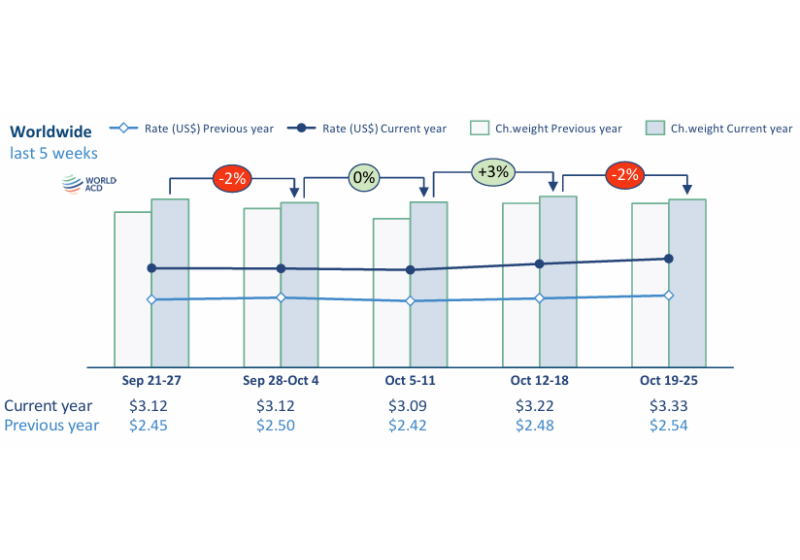
According to the latest weekly figures from WorldACD Market Data, global spot prices in week 43 (19 to 25 October) rose by an average of +5%, week on week (WoW), a similar pattern seen in week 43 last year – driven by +7% from Europe, +6% WoW spot rate rises from Asia Pacific and +5% from Central & South America (CSA). The increases follow a +4% WoW rise in global spot rates in week 42 and take average worldwide spot rates to US$3.80 per kilo, which is +38% higher, year on year (YoY). And worldwide full-market rates, a mix of spot prices and contract rates, rose +3%, WoW, to $3.33 per kilo, up +31% YoY.
Worldwide tonnages, meanwhile, dropped by -2%, WoW, with small declines of -1% or -2% from most of the major world regions with the exception of the Middle East & South Asia (MESA), which recorded a -6% WoW drop in volumes, due chiefly to declines from India and Sri Lanka linked to national holidays. Compared with last year, volumes in week 43 were up by +2%.
Global air cargo capacity dipped slightly (-1%, WoW) in week 43, including a -1% WoW drop from Asia Pacific origins that was largely due to a typhoon that disrupted flights in Taiwan, although worldwide capacity was slightly (+1%) up compared with the equivalent week last year, mainly thanks to increases in freighter services. Capacity remains constrained by the ongoing tensions in the Middle East, with Riyadh almost completely closed to international flights in week 43. Capacity from MESA in week 43 was down by -13% compared with its level in late February (week 7) just prior to the start of the US-Israel war against Iran, with capacity from the Arabian Gulf down by -19% compared with week 7.
Examining demand patterns more closely from the key Asia Pacific region highlights the big difference in the performance of European and US markets, especially since the European Union (EU) eliminated its ‘de minimis’ exemptions on lower-value items worth less than €150 from 1 July. Chargeable weight from Asia Pacific to the EU in week 43 was down by -16%, YoY, whereas volumes from Asia Pacific to the US were up by +9%, YoY.
Part of the difference is very strong ongoing demand this year in the US for AI-related high-tech air imports, particularly from Taiwan and parts of Southeast Asia, but the other key difference is the big drop in volumes to the EU from Hong Kong (HK) and mainland China (CN) since 1 July. Tonnages from HK to the EU in week 43 were down by one third (-33%), YoY, and from mainland China (CN) by -9%, whereas tonnages from CN/HK to the US are slightly up, YoY. An additional new EU €2 per item import handling fee starting on 1 November may also affect CN/HK volumes to Europe.
Nevertheless, markets from Asia Pacific to both the US and EU are commanding high prices currently, as carriers are faced with high jet fuel costs. Spot rates from Asia Pacific to the US in week 43 rose by a further +7%, WoW, to an average of $7.43 per kilo, rising particularly sharply from South Korea (+26%, WoW), mainland China (+15%, WoW), and Japan (+14%, WoW). Compared with last year, average Asia Pacific to US spot rates in week 43 were +41% higher, with particularly big YoY increases from Japan (+59%) South Korea (+55%), Indonesia (+53%), Thailand (+47%), and Singapore (+46%), while rates from China and Hong Kong were up by around +40%, YoY.
Meanwhile, average spot prices from Asia Pacific to Europe rose by a further +5%, WoW, in week 43, to $5.10 per kilo, including a +10% WoW increase from Vietnam and a +6% increase from mainland China origins. That takes Asia Pacific to Europe spot prices up by almost +30%, YoY, with HK (+17%) and CN (+20%) at the lower end of the YoY rate rises compared with more than +40% from many other major Asia Pacific origin markets including South Korea (+54%), Japan (+47%) and Thailand (+47%).
With strong demand from many Asia Pacific and South Asia markets, continuing instability in the Arabian Gulf, and with Diwali, Thanksgiving, Black Friday and Christmas coming up, air cargo stakeholders face a busy but somewhat uncertain peak season period, but with the current sustained high rates likely to increase further in the coming weeks.